Overview A child's primary teeth, sometimes called "baby teeth," are as important as the permanent adult teeth. Primary teeth typically begin to appear when a baby is between age six months and one year. Primary teeth help children chew and speak. They also hold space in the jaws for permanent teeth that are growing under the gums. The ADA recommends that a dentist examine a child within six months after the first tooth comes in and no later than the first birthday. A dental visit at an early age is a "well baby checkup" for the teeth. Besides checking for tooth decay and other problems, the dentist can show you how to clean the child's teeth properly and how to evaluate any adverse habits such as thumbsucking.
The Teething Cycle
When teeth first come in, some babies may have sore or tender gums. Gently rubbing your child's gums with a clean finger, a small, cool spoon or a wet gauze pad can be soothing. You can also give the baby a clean teething ring to chew on. If your child is still cranky and in pain, consult your dentist or physician. Most children have a full set of 20 primary teeth by the time they are three years old.
Primary Teeth Eruption Chart
Keeping Your Child’s Teeth Healthy
Begin cleaning the baby's mouth during the first few days after birth. After every feeding, wipe the baby's gums with a clean gauze pad. This removes plaque (a sticky film of bacteria) and residual food that can harm erupting teeth.
As soon as teeth appear in the mouth, tooth decay can occur. Therefore, when your child's teeth begin to erupt, brush them gently with a child's size toothbrush and water. Brush the teeth of children over age two with a pea-sized amount of fluoride toothpaste. Be sure they spit out the toothpaste and rinse with water. (Ask your child's dentist or physician if you are considering using fluoride toothpaste before age two.)
Infants should finish their bedtime and naptime bottle before going to bed. If you use a pacifier, use a clean one. Never dip a pacifier in sugar or honey before giving it to a baby. (Ask your child's physician or dentist to recommend a type of pacifier.)
Monday, February 27, 2012

Dental Care for Your Baby
Dental Care for Your Baby
Q. When should my child first see a dentist?
"First visit by first birthday" sums it up. Your child should visit a pediatric dentist when the first tooth comes in, usually between 6 and 12 months of age. This visit will establish a dental home for your child. Early examination and preventive care will protect your child’s smile now and in the future.
Q. Why so early? What dental problems could a baby have?
The most important reason is to begin a thorough prevention program. Dental problems can begin early. A big concern is Early Childhood Caries (formerly known as baby bottle tooth decay or nursing caries). Once a child’s diet includes anything besides breast-milk, erupted teeth are at risk for decay. The earlier the dental visit, the better the chance of preventing dental problems. Children with healthy teeth chew food easily and smile with confidence. Start your child now on a lifetime of good dental habits.
Q. How can I prevent tooth decay from nursing or using a bottle?
At-will breast-feeding should be avoided after the first primary (baby) teeth begin to erupt and other sources of nutrition have been introduced. Children should not fall asleep with a bottle containing anything other than water. Drinking juice from a bottle should be avoided. Fruit juice should only be offered in a cup with meals or at snack time.
Q. When should bottle-feeding be stopped?
Children should be weaned from the bottle at 12-14 months of age.
Q. Should I worry about thumb and finger sucking?
Thumb sucking is perfectly normal for infants; many stop by age 2. Prolonged thumb sucking can create crooked teeth or bite problems. If the habit continues beyond age 3, a professional evaluation is recommended. Your pediatric dentist will be glad to suggest ways to address a prolonged thumb sucking habit.
Q. When should I start cleaning my baby’s teeth?
The sooner the better! Starting at birth, clean your child’s gums with a soft infant toothbrush or cloth and water. As soon as the teeth begin to appear, start brushing twice daily using fluoridated toothpaste and a soft, age-appropriate sized toothbrush. Use a "smear" of toothpaste to brush the teeth of a child less than 2 years of age. For the 2-5 year old, dispense a "pea-size" amount of toothpaste and perform or assist your child’s toothbrushing. Remember that young children do not have the ability to brush their teeth effectively.
Q. Any advice on teething?
From six months to age 3, your child may have tender gums when teeth erupt. Many children like a clean teething ring, cool spoon or cold wet washcloth. Some parents swear by a chilled ring; others simply rub the baby’s gums with a clean finger.
Q. When should my child first see a dentist?
"First visit by first birthday" sums it up. Your child should visit a pediatric dentist when the first tooth comes in, usually between 6 and 12 months of age. This visit will establish a dental home for your child. Early examination and preventive care will protect your child’s smile now and in the future.
Q. Why so early? What dental problems could a baby have?
The most important reason is to begin a thorough prevention program. Dental problems can begin early. A big concern is Early Childhood Caries (formerly known as baby bottle tooth decay or nursing caries). Once a child’s diet includes anything besides breast-milk, erupted teeth are at risk for decay. The earlier the dental visit, the better the chance of preventing dental problems. Children with healthy teeth chew food easily and smile with confidence. Start your child now on a lifetime of good dental habits.
Q. How can I prevent tooth decay from nursing or using a bottle?
At-will breast-feeding should be avoided after the first primary (baby) teeth begin to erupt and other sources of nutrition have been introduced. Children should not fall asleep with a bottle containing anything other than water. Drinking juice from a bottle should be avoided. Fruit juice should only be offered in a cup with meals or at snack time.
Q. When should bottle-feeding be stopped?
Children should be weaned from the bottle at 12-14 months of age.
Q. Should I worry about thumb and finger sucking?
Thumb sucking is perfectly normal for infants; many stop by age 2. Prolonged thumb sucking can create crooked teeth or bite problems. If the habit continues beyond age 3, a professional evaluation is recommended. Your pediatric dentist will be glad to suggest ways to address a prolonged thumb sucking habit.
Q. When should I start cleaning my baby’s teeth?
The sooner the better! Starting at birth, clean your child’s gums with a soft infant toothbrush or cloth and water. As soon as the teeth begin to appear, start brushing twice daily using fluoridated toothpaste and a soft, age-appropriate sized toothbrush. Use a "smear" of toothpaste to brush the teeth of a child less than 2 years of age. For the 2-5 year old, dispense a "pea-size" amount of toothpaste and perform or assist your child’s toothbrushing. Remember that young children do not have the ability to brush their teeth effectively.
Q. Any advice on teething?
From six months to age 3, your child may have tender gums when teeth erupt. Many children like a clean teething ring, cool spoon or cold wet washcloth. Some parents swear by a chilled ring; others simply rub the baby’s gums with a clean finger.

Definition of Primary teeth
Primary teeth: The first teeth which are shed and replaced by permanent teeth. The first primary tooth comes in at about 6 months of age and the 20th and last primary tooth erupts at around 2 1/2 years of age. The primary teeth are replaced beginning usually at about age 6. Also called baby teeth, milk teeth, temporary teeth or deciduous teeth. (In Latin, decidere means to fall off or be shed, like leaves from a tree).
http://images.medicinenet.com/images/slideshow/feature_cosmeticDentistry.jpg
http://images.medicinenet.com/images/slideshow/feature_cosmeticDentistry.jpg

Primary Teeth
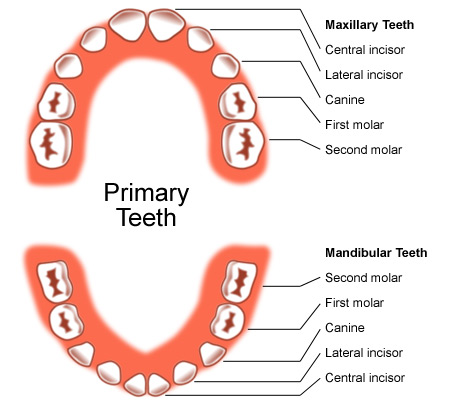
Primary Teeth
Primary teeth (baby teeth or deciduous teeth) are teeth that appear in the mouth of a child and stay there for some years before falling and leaving their place to permanent teeth. There are 20 deciduous teeth including eight incisors, four canines, and eight molars.
They begin to come out from the gums around the age of 6 to 7 months, normally starting with the two lower central incisors. The second primary molars emerge between 24 and 30 months. The set of deciduous teeth should therefore have completed full eruption around the age of 3 years and any delay of more than one year of this chronology is to be regarded as pathological.
Primary teeth have anatomical and physiological differences when compared to permanent teeth. The enamel is thinner and more translucent, making teeth look paler. The enamel is also less mineralized, whereas dental cavities and baby bottle tooth decay become more common. The pulp chamber is larger; therefore if an aggressive cavity is to form, dental abscesses arise more easily.
Eruption Pattern of Primary Teeth
Upper Teeth Eruption Time Age of Loss of Tooth
Central Incisor 8 to 12 months 6 to 7 years old
Lateral Incisor 9 to 13 months 7 to 8 years old
Cuspid 16 to 22 months 10 to 12 years old
First Molar 13 to 19 months 9 to 11 years old
Second Molar 25 to 33 months 10 to 12 years old
Lower Teeth Eruption Time Age of Loss of Tooth
Central Incisor 6 to 10 months 6 to 7 years old
Lateral Incisor 10 to 16 months 7 to 8 years old
Cuspid 17 to 23 months 9 to 12 years old
First Molar 14 to 18 months 9 to 11 years old
Second Molar 23 to 31 months 10 to 12 years old
Tuesday, January 31, 2012

Dental costs
Dental charges depend on the treatment you need to keep your mouth, teeth and gums healthy. You will only ever be asked to pay one charge for each complete course of treatment, even if you need to visit your dentist more than once to finish it. If you are referred to another dentist for another, separate course of treatment, you can expect a second charge. Some minor treatments are free.
NHS dental charges from 1 April 2011
Band 1 course of treatment – £17.00
This covers an examination, diagnosis (eg X-rays), advice on how to prevent future problems, a scale and polish if needed, and application of fluoride varnish or fissure sealant. If you require urgent care, even if your urgent treatment needs more than one appointment to complete, you will only need to pay one Band 1 charge.
Band 2 course of treatment – £47.00
This covers everything listed in Band 1 above, plus any further treatment such as fillings, root canal work or if your dentist needs to take out one or more of your teeth.
Band 3 course of treatment – £204.00
This covers everything listed in Bands 1 and 2 above, plus crowns, dentures and bridges.
Detailed information about each treatment band can be found in the NHS dental treatments section.
Thursday, June 3, 2010
Dental Health and Tooth Discoloration
There are several causes of tooth discoloration, including:
Foods/drinks. Coffee, tea, colas, wines, and certain fruits and vegetables (for example, apples and potatoes) can stain your teeth.
Tobacco use. Smoking or chewing tobacco can stain teeth.
Poor dental hygiene. Inadequate brushing and flossing to remove plaque and stain-producing substances like coffee and tobacco can cause tooth discoloration.
Disease. Several diseases that affect enamel (the hard surface of the teeth) and dentin (the underlying material under enamel) can lead to tooth discoloration. Treatments for certain conditions can also affect tooth color. For example, head and neck radiation and chemotherapy can cause teeth discoloration. In addition, certain infections in pregnant mothers can cause tooth discoloration in the infant by affecting enamel development.
Medications. The antibiotics tetracycline and doxycycline are known to discolor teeth when given to children whose teeth are still developing (before the age of 8). Mouth rinses and washes containing chlorhexidine and cetylpyridinium chloride can also stain teeth. Antihistamines (like Benadryl), antipsychotic drugs, and drugs for high blood pressure also cause teeth discoloration.
Dental materials. Some of the materials used in dentistry, such as amalgam restorations, especially silver sulfide-containing materials, can cast a gray-black color to teeth.
Advancing age. As you age, the outer layer of enamel on your teeth gets worn away revealing the natural yellow color of dentin.
Genetics. Some people have naturally brighter or thicker enamel than others.
Environment. Excessive fluoride either from environmental sources (naturally high fluoride levels in water) or from excessive use (fluoride applications, rinses, toothpaste, and fluoride supplements taken by mouth) can cause teeth discoloration.
Trauma. For example, damage from a fall can disturb enamel formation in young children whose teeth are still developing. Trauma can also cause discoloration to adult teeth.
Foods/drinks. Coffee, tea, colas, wines, and certain fruits and vegetables (for example, apples and potatoes) can stain your teeth.
Tobacco use. Smoking or chewing tobacco can stain teeth.
Poor dental hygiene. Inadequate brushing and flossing to remove plaque and stain-producing substances like coffee and tobacco can cause tooth discoloration.
Disease. Several diseases that affect enamel (the hard surface of the teeth) and dentin (the underlying material under enamel) can lead to tooth discoloration. Treatments for certain conditions can also affect tooth color. For example, head and neck radiation and chemotherapy can cause teeth discoloration. In addition, certain infections in pregnant mothers can cause tooth discoloration in the infant by affecting enamel development.
Medications. The antibiotics tetracycline and doxycycline are known to discolor teeth when given to children whose teeth are still developing (before the age of 8). Mouth rinses and washes containing chlorhexidine and cetylpyridinium chloride can also stain teeth. Antihistamines (like Benadryl), antipsychotic drugs, and drugs for high blood pressure also cause teeth discoloration.
Dental materials. Some of the materials used in dentistry, such as amalgam restorations, especially silver sulfide-containing materials, can cast a gray-black color to teeth.
Advancing age. As you age, the outer layer of enamel on your teeth gets worn away revealing the natural yellow color of dentin.
Genetics. Some people have naturally brighter or thicker enamel than others.
Environment. Excessive fluoride either from environmental sources (naturally high fluoride levels in water) or from excessive use (fluoride applications, rinses, toothpaste, and fluoride supplements taken by mouth) can cause teeth discoloration.
Trauma. For example, damage from a fall can disturb enamel formation in young children whose teeth are still developing. Trauma can also cause discoloration to adult teeth.
Friday, May 7, 2010
Yellowing Teeth

Yellowing Teeth
Why do my teeth have a yellow tinge, and how do I get rid of it?
By Dr. Rob for MSN Health & FitnessQ: I'm 45 years old and my teeth are no longer white. They have a yellowish tinge. What causes the color change and how can I prevent it?
A: When your teeth begin to change color, there may be a variety of reasons. If your parents have yellowish teeth, you may be headed toward that same hue. Thus, heredity may be the culprit. In addition, lifestyle issues like consumption of enamel-tinting liquids such as coffee or tea, poor dental hygiene, and older age can contribute. A visit with your family dentist will go a long way toward creating an enamel friendly treatment plan that gets your teeth back to their more "natural" color.
The anatomy of the tooth
The most visible part of our teeth is called enamel. This is an extremely hard substance, designed to withstand biting and chewing. While very durable, the enamel is also prone to chipping, cracking and thinning as one gets older. If the enamel is extremely well mineralized it will appear lighter or white in color. However, the enamel is often translucent, taking most of its light-gray/white or light yellow color from the bone-like substance underneath, known as dentin. This tissue is strong, makes up the majority of the structure of the tooth, and serves as a support for the enamel.
The core of the tooth, beneath the dentin, is known as the pulp cavity. The pulp cavity is made up of blood vessels (which supply vital nutrients that help to keep the tooth alive), tissue, and nerves that make up the pulp. The part of the pulp that lies in the root is called the root canal, through which blood vessels and nerves enter the tooth to become part of the pulp.
Reasons for the color change
While many individuals have very light or whiter shades in their teeth, others have a naturally occurring yellowish tint to their teeth. The key is in knowing what is or was the natural color of your teeth. You can then work with a dental-health professional to find the cause for the color change. Here are a few reasons to consider:
Intrinsic stains affect the color of the structures on the inside of the tooth (usually the dentin) either before or after it appeared in the mouth. Reasons for this change include hereditary conditions, illness (hyperbilirubinemia, etc.) and excessive intake of fluoride (which can cause white or brown marks), as well as certain medications (like tetracycline) ingested before eight years of age. Additionally, trauma can lead to bleeding within the pulp of the tooth and, in turn, cause a change in color. It's also possible for a tooth to darken after a root-canal procedure.
Extrinisic stains involve a color change either directly on the enamel, or through cracks and fissures on the tooth surface. Stains can be caused by the following:
Foods (blueberries, curry, soy sauce) and drinks (coffee, tea, cola, red wine, dark beer), especially those that are acidic
Tobacco smoking or chewing
Poor dental hygiene leading to the formation of tartar and plaque, which in turn makes it easier for stains to accumulate from foods, drinks or tobacco
Dental materials, such as the color of restorative material that may show through the translucent appearance of the enamel
Supplements containing iron
Overuse of prescription mouthwash containing chlorhexidine and cetylpyridinium chloride
Excessive intake of fluoride due to unusually high levels in the water, or through the consistent and intentional ingestion of fluoride from toothpaste and/or mouthwash
Medications that may include antihistamines, antipsychotics, and those used to control high blood pressure. For the best information in this category, please check with your pharmacist.
Age contributes to wear and tear of your teeth. Even though you are a relatively young 45 years of age, your teeth, over time, experience a thinning of the enamel. As a result, they will more closely reflect the natural color of the dentin inside the enamel.
Preventing discoloration
Fortunately, there's a lot you can do to halt any further discoloration. For starters, avoid as many of the extrinsic causes of stains as possible. Next, brush your teeth after meals to help remove the buildup of staining foods or drinks. Also, daily flossing can decrease bacterial buildup between teeth, while improving your overall dental health.
As for removing some of the dental stains and discoloration, it's best to visit your family dentist before using any over the counter whitening agents. These professionals have many options available, including bleaching and/or non-bleaching agents, as well as bonding and veneers.
For further information, please visit the American Academy of Cosmetic Dentistry and the American Dental Association.
Find More on MSN Health & Fitness:
What Toothpaste Do You Use?
Bad Breath: Five Causes and Five Cures
Dental Care: 22 Tips to Chew On
Conquering Canker Sores
A Bad Taste in Your Mouth?
MSN Health Centers: Oral Health
Find all articles by Dr. Rob.
Do you have a health question you'd like to ask Dr. Rob? Send e-mail to experts@microsoft.com. Please include Ask Dr. Rob in the subject line.
Each of our experts responds to one question each week and the responses are posted on Mondays on MSN Health. We regret that we cannot provide a personalized response to every submission.
Robert Danoff, D.O., M.S., is a family physician and program director of The Family Practice Residency, as well as the combined Family Practice/Emergency Medicine Residency programs at Frankford Hospitals, Jefferson Health System, Philadelphia, Pa. He is the medical correspondent for CN8, The Comcast Network, a regular contributor to Discovery Health Online and a contributing writer to The New York Times Special
Subscribe to:
Posts (Atom)